
Planet & Ocean Discovery Series: Guam - Open Ocean
Habitats & Adaptations
Background
Characterized by deep waters with varying depths, currents, and temperatures, this ecosystem is home to an array of marine organisms adapted to thrive. Adaptations include streamlined bodies and fins for swimming, large tails, keen senses, sophisticated hunting strategies, and special respiratory systems for oxygen intake. Characterized by deep waters with varying depths, currents and temperature, this ecosystem is home to an array of marine organisms adapted to thrive. With varying depths comes varying currents. Strong ocean currents, like the Kuroshio Current, can influence the local marine environment, bringing nutrients and marine organisms to the area. Physical adaptations include streamlined bodies and fins for swimming, large tails, keen senses and sophisticated hunting strategies, and special respiratory systems for oxygen intake. Behavioral adaptations include schooling, migration, and nocturnal behaviors. For example, some species of fish come together by the hundreds to form a school, which can provide protection from predators and improve the way they catch their food. Alongside the physical and the behavioral adaptations are the physiological adaptations. Physiological adaptations include salt tolerance, temperature tolerance, and pressure tolerance. Fish must be able to adapt to different levels of the environment, for example, fish on Guam have adapted to survive in freshwater and saltwater environments. Fish have also adapted to changing temperatures and depths considering it varies significantly throughout Guam waters.
Key Vocabulary
Adaptations
Atmospheric Pressure
Behavior
Echolocation
Electroreception
Endangered
Olfaction
Physiologcal
Predator
Prey
Resistance
Learning Objectives
- Students will be able to identify and describe adaptations of marine organisms in deep-water ecosystems that aid in survival.
- Students will be able to explain how marine organisms adapt to varying depths, currents, and temperatures within deep-water ecosystems and the benefits of these adaptations.
- Students will be able to compare and contrast the adaptations of different marine organisms, noting similarities and differences.
LS1.A: Structure and Function; Students will understand that organisms have specialized structures that serve distinct purposes. For example, they will learn how streamlined bodies and fins enable efficient movement.
LS1.D: Information Processing; Students will discover that marine organisms exhibit a range of senses beyond the traditional five, and their hunting strategies involve sophisticated information processing.
LS1.C: Organization for Matter and Energy Flow in Organisms; Students will learn that adaptations in respiratory systems, like gills and swim bladders, enable marine organisms to efficiently absorb oxygen.
LS4.C – Adaptation; Students will learn about specific adaptations that enable organisms to thrive in diverse environments, including those with low oxygen or anaerobic conditions.
Body Type
Streamlined bodies and fins are adaptations useful to animals that need to move smoothly with the flow of water. The streamlined body allows the animal to cut through the water with minimal resistance, enabling easier and more efficient swimming. This adaptation is particularly beneficial in the waters around Guam, where ocean currents can be strong and unpredictable.
In the marine ecosystems surrounding Guam, predator species such as reef sharks and certain species of large fish have evolved streamlined bodies and fins to enhance their hunting efficiency. The streamlined shape allows them to achieve greater speeds and agility, making it easier to catch fast-moving prey such as smaller fish and squid. For example, the blacktip reef shark, commonly found around Guam, uses its streamlined body to swiftly navigate through coral reefs and open waters, effectively pursuing its prey. Additionally, their fins provide stability and maneuverability, allowing them to make quick, sharp turns during a chase.
Prey species in Guam’s waters, such as various types of tuna and mackerel, have also developed streamlined bodies to outswim predators and evade capture. These fish exhibit streamlined shapes that allow them to swim at high speeds, crucial for escaping predators like sharks and larger fish. Their fins help maintain balance and stability, aiding them in navigating swiftly through the water to avoid being caught.
The streamlined body shape also increases stability in the turbulent and often unpredictable waters around Guam. This stability is essential for both predator and prey species, as it helps them maintain control and orientation while swimming, conserving energy, and avoiding disorientation. The streamlined design reduces turbulence and drag, allowing marine animals to swim more efficiently over long distances, which is particularly important in the open waters and around the coral reefs of Guam where food sources may be scattered.
Additionally, their fins provide stability and maneuverability, allowing them to make quick, sharp turns during a chase.
Senses & Hunting Strategies
In the vast expanse of the open ocean, the hunt for food is a constant dance between predator and prey. Survival depends on sharp senses and clever hunting tactics. Marine life has evolved diverse adaptations to sense their surroundings and find food, even though they may not have the same five senses as humans.
- Electricity: Sharks and some bony fish can sense the weak electrical fields emitted by living organisms, allowing them to locate prey hidden in murky water or buried in the sand.
- Gravity: Certain fish and invertebrates use highly sensitive organs (otoliths) to detect minute changes in gravity, aiding in navigation and vertical movement in the water column.
- Water Pressure: Many marine animals, including dolphins and whales, possess a sophisticated sense of pressure. This allows them to perceive depth, locate underwater features, and even detect approaching predators.
- Atmospheric Pressure: Fish can sense changes in atmospheric pressure, which can help them predict weather patterns and locate feeding grounds.
These diverse senses work together to paint a detailed picture of the surrounding environment. Olfaction (smell) plays a crucial role for many species. Sharks can detect blood in the water from miles away, while fish and turtles use scent trails to navigate vast distances, like following an invisible map.
Vision is another critical tool, especially for predators that rely on sight to locate prey. Excellent eyesight allows fish like tuna to spot schools of baitfish or bioluminescent flashes at night, while the keen vision of marlin helps them target fast-moving prey near the surface.
Hearing plays a vital role as well. Predators like dolphins use echolocation, emitting sound waves and interpreting the echoes to build a three-dimensional image of their surroundings. This allows them to hunt effectively in low-light conditions or murky water.
The hunting strategies employed in the open ocean are as diverse as the senses themselves. Some predators, like blue marlin, are ambush hunters, relying on their speed and agility to surprise and overpower prey. Others, like yellowfin tuna, utilize their schooling behavior to herd baitfish into a tight ball, making them easier to catch. Opportunistic feeders like mahi-mahi simply snatch prey that comes near the surface or scavenge around floating objects.
By combining their exceptional senses with a variety of hunting tactics, marine predators of the open ocean have become masters of their environment. This ongoing evolutionary arms race, where predators refine their senses and hunting strategies, and prey develop counter-adaptations, ensures a dynamic and ever-changing dance for survival in the vast blue expanse.
The Buoyancy Advantage
Efficient movement and hunting in the open ocean require constant energy conservation. Bony fish, unlike land animals with lungs, rely on gills to extract oxygen dissolved in water. But maintaining position in the water column can be a challenge. Here’s where the swim bladder comes in. This gas-filled internal sac acts like a buoyancy control device. By adjusting the gas content within the bladder, fish can effortlessly stay at their desired depth without expending extra energy on constant swimming motions. This adaptation allows them to focus their energy on hunting and other activities, giving them a significant advantage in the open ocean.
The swim bladder can also be sensitive to pressure changes. As pressure changes, the gas in the swim bladder expands or contracts, which fish can likely detect.
Summary
Guam’s deep waters pose a challenge with fluctuating depths, currents, and temperatures. Despite this, a wide variety of marine life thrives here thanks to amazing adaptations.
Both predators and prey share a sleek body and fin design for efficient movement. Sharks use electroreception to sense prey’s electrical fields, while fish navigate with otoliths that detect pressure changes. Dolphins and others use water pressure to perceive depth and even predators. Fish can even sense air pressure, potentially predicting weather and finding food.
Smell is another key sense. Sharks detect blood from afar, while fish and turtles navigate by scent trails. Vision is crucial for predators like tuna and marlin, with some fish seeing bioluminescence. Dolphins use echolocation, sound waves to “see” in the dark.
Hunting strategies are diverse. Blue marlin ambush prey with speed, while yellowfin tuna herd baitfish for easier capture. Opportunistic feeders like mahi-mahi snatch surface prey.
These adaptations make Guam’s deep-sea creatures masters of their ever-changing environment.
Environmental Importance
Background
The open ocean plays a critical role in supporting biodiversity and sustaining marine food webs by providing a habitat for a wide range of species, including fish, migratory species, and pelagic organisms. These species influence the distribution and abundance of species throughout the region. Additionally, the open ocean acts as a carbon sink, absorbing atmosphere carbon dioxide, which helps regulate global climate.
Key Vocabulary
Biodiversity
Carbon cycle
Carbon sink
Energy
Habitat
Food web
Interdependence
Pelagic
Photosynthesis
Learning Objectives
- Students will be able to explain how producers, herbivores, carnivores, and omnivores in the ocean interact through feed relationships.
- Students will be able to analyze how changes in one population can cascade through the food web.
- Students will be able to identify the role of phytoplankton in the carbon cycle and its importance for a healthy environment.
- Students will be able to explain how the ocean acts as a carbon sink, absorbing carbon dioxide from the atmosphere.
Next Generation Science Standards Alignment
LS2.A: Interdependent Relationships in Ecosystems –The intricate web of the marine food web exemplifies interdependent relationships within an ecosystem. Primary producers, like phytoplankton, capture energy from the sun and form the base of this food chain. These producers are consumed by primary consumers, such as zooplankton, who transfer energy to the next level. Secondary consumers, including fish and smaller shrimp, then feed on the primary consumers. Finally, tertiary consumers, like larger fish and sharks, occupy the top of the food chain by preying on secondary consumers. This interconnected web demonstrates how all organisms in the marine ecosystem rely on each other for survival and the flow of energy.
LS2-5: Ecosystem Dynamics, Function, and Biodiversity – Within a marine food web, changes in one population can have cascading effects on other populations. Imagine a scenario where overfishing significantly reduces the population of a specific type of fish (primary consumer) that feeds on plankton (primary producer). This decrease in fish would lead to an increase in plankton populations as there are fewer predators to consume them. However, an unchecked rise in plankton could deplete the nutrients available for other organisms, ultimately affecting the entire food web. This example demonstrates how a seemingly isolated change in one population can have rippling effects throughout the interconnected web of marine life.
Marine Food Web
Guam hosts a unique and intricate marine food web. This ecosystem is characterized by a complex network of interactions among various species, all driven by the need to obtain energy and matter to sustain life. The marine food web in the open ocean around Guam involves producers, consumers, and decomposers, each playing a crucial role in maintaining ecological balance.
Marine Producers
In the open ocean around Guam, the primary producers are predominantly phytoplankton. These microscopic, photosynthetic organisms are the foundation of the marine food web, converting sunlight, carbon dioxide, and nutrients into organic matter through photosynthesis. Phytoplankton productivity is critical in supporting the entire marine ecosystem, as they are the primary source of energy for a wide range of organisms.
Primary Consumers
Primary consumers in Guam’s open ocean include various species of zooplankton, small pelagic fish, and other invertebrates that feed on phytoplankton. Copepods, krill, and other zooplankton are vital links in the food web, transferring energy from the primary producers to higher trophic levels. Small fish such as sardines and anchovies also play a significant role as primary consumers, feeding on zooplankton and smaller phytoplankton.
Secondary and Tertiary Consumers
Secondary consumers in the open ocean around Guam consist of larger fish, cephalopods, and some marine mammals. These organisms prey on the primary consumers. For example, tuna, mackerel, and dolphinfish are significant secondary consumers that feed on smaller fish and zooplankton. Cephalopods like squid are also important secondary consumers, preying on smaller fish and crustaceans.
Tertiary consumers include larger predatory fish, marine mammals, and seabirds. Apex predators such as sharks, billfish (like marlins and swordfish), and certain species of dolphins prey on secondary consumers, maintaining the balance of marine populations and contributing to the health of the ecosystem.
Apex Predators
In Guam’s open ocean, apex predators such as oceanic whitetip sharks, mako sharks, blue sharks, large tuna species, marlins, and bottlenose dolphins play crucial roles in maintaining the balance of the marine ecosystem. They regulate prey populations, ensuring healthy species diversity and preventing overpopulation of certain species. These top predators are essential for the overall stability and resilience of the oceanic food web around Guam.
Decomposers
Decomposers in the open ocean, including bacteria and fungi, break down dead organic matter, recycling nutrients back into the ecosystem. This decomposition process is essential for maintaining the productivity of the open ocean, supporting the growth of phytoplankton and other primary producers.
Carbon Cycle
The carbon cycle is the process by which carbon is exchanged between the atmosphere, ocean, and land. It plays a critical role in regulating the Earth’s climate and maintaining biodiversity.
The carbon cycle is mainly driven by photosynthesis, which is the process by which plants, algae, and some bacteria convert sunlight and carbon dioxide into oxygen and organic compounds. This process is performed by phytoplankton, which is the base of the marine food web and responsible for a large part of the Earth’s oxygen production.
Variations in the availability of nutrients and light can significantly impact the carbon cycle. Changes in nutrient availability, such as nitrogen and phosphorus, can affect the growth and productivity of phytoplankton. Similarly, fluctuations in light intensity and duration due to factors like seasonal changes or water turbidity can influence the rate of productivity of phytoplankton and overall carbon fixation in the ecosystem.
Summary
The open ocean surrounding Guam serves as a vital ecosystem supporting diverse marine life and playing a crucial role in global environmental processes. It provides habitat for a wide array of species, including migratory fish and pelagic organisms, which contribute to the region’s biodiversity and sustain complex food webs. Additionally, the open ocean acts as a significant carbon sink, absorbing atmospheric carbon dioxide through processes like photosynthesis by phytoplankton. This carbon sequestration helps regulate global climate patterns, highlighting the ecosystem’s essential role in maintaining ecological balance and supporting human well-being.
The Changing Climate
Background
The open ocean waters around Guam are heavily impacted by climate change, with rising temperatures and ocean acidification threatening marine biodiversity and ecosystem stability. These changes affect nutrient availability, disrupt food webs, and alter fish populations, crucial for local fisheries. Effective management and adaptive strategies are essential to sustain marine life and coastal communities reliant on fishing. Like other oceanic regions, the open ocean surrounding Guam is affected by the changing climate. Rising sea temperatures can influence the distribution and biodiversity of marine species, ultimately altering population dynamics. Ocean acidification from the increase carbon dioxide absorption poses a threat to shellfish and corals. Changes in ocean currents and weather patterns can also affect the availability of nutrients, leading to a cascade of effects throughout the food chain, ultimately affecting food webs.
Key Vocabulary
Acidification
Biodiversity
Bottom-up theory
Climate
El Niño
La Niña
Trophic level
Learning Objectives
- Students will be able to describe the role of ocean currents in influencing the climate and biodiversity around Guam.
- Students will be able to analyze how El Niño and La Niña phenomena affect ocean currents and weather patterns, and their impact on marine ecosystems.
- Students will be able to evaluate the effects of nutrient availability on the marine food chain, demonstrating how changes at one trophic level can impact others.
- Students will be able to assess the significance of shipping and navigation in Guam’s economy and the importance of following MARPOL regulations to protect marine environments.
Next Generation Science Standards Alignment
ESS2.C: The Roles of Water in Earth’s Surface Processes: The students will learn about ocean currents and how they influence the distribution of water mass and heat.
ESS2.D: Weather and Climate: The students will learn how El Niño and La Niña phenomena connect with the impact of weather patterns on climate, emphasizing recurring climate patterns and their effects on ocean currents.
LS2.C: Ecosystem Dynamics, Functioning, and Resilience: The students will learn that nutrient availability impacts the marine food chain, demonstrating the dynamics, functionality, and resilience of ecosystems.
Rising Temperatures
As sea temperatures rise, marine species in the open ocean around Guam are forced to adapt by migrating to cooler waters. This migration can lead to shifts in species distribution, potentially introducing new species to the region while causing local extinctions of those unable to adapt or move. For example, tropical fish species may extend their range, while species adapted to cooler temperatures may retreat or face decline.
Influence on Metabolism and Reproduction
Increased temperatures can accelerate the metabolism of marine organisms, leading to higher energy requirements. For some species, this can enhance growth rates and reproduction, while for others, it may cause stress and reduce reproductive success. Species with narrow temperature tolerance ranges are particularly vulnerable, potentially leading to decreased biodiversity in the region.
Impacting Marine Food Webs
Temperature changes can disrupt the timing of biological events, such as phytoplankton blooms and the breeding cycles of zooplankton and fish. These mismatches can have cascading effects throughout the food web, impacting predator-prey relationships and the availability of food for higher trophic levels, including commercially valuable fish species.
Ocean Acidification
Ocean acidification is caused by the absorption of excess atmospheric carbon dioxide (CO2) by seawater, forming carbonic acid. This process decreases the pH of the water, making it more acidic. The open ocean around Guam, being directly exposed to atmospheric changes, is particularly susceptible to these chemical shifts.
When atmospheric CO2 dissolves in seawater, it reacts with water molecules to form carbonic acid (H2CO3). Carbonic acid is unstable and quickly dissociates into bicarbonate ions (HCO3-) and hydrogen ions (H+). The increase in hydrogen ions lowers the pH of seawater, resulting in a more acidic environment. Additionally, these hydrogen ions can combine with carbonate ions (CO32-) to form more bicarbonate ions.
The reduction in available carbonate ions is critical because many marine organisms, such as shellfish and certain types of plankton, rely on carbonate ions to form their calcium carbonate (CaCO3) shells and skeletons.
Nutrient Cycling and Productivity
As the surface waters around Guam warm due to rising temperatures, the density difference between warmer surface waters and cooler, deeper waters increases. This creates a more stratified water column, where layers of water with different temperatures (and therefore different densities) form distinct strata that do not mix easily.
In a stratified water column, the lack of vertical mixing means that nutrient-rich waters from the deep cannot easily rise to the surface. Deep waters are typically rich in nutrients such as nitrates, phosphates, and silicates, which are essential for the growth of phytoplankton (the primary producers in the ocean).
This can lead to reduced upwelling. Upwelling is a process where deep, nutrient-rich waters are brought to the surface, typically driven by wind and ocean currents. Warmer surface temperatures can weaken these upwelling processes, further limiting the supply of nutrients to the surface waters.
Shipping & Navigation
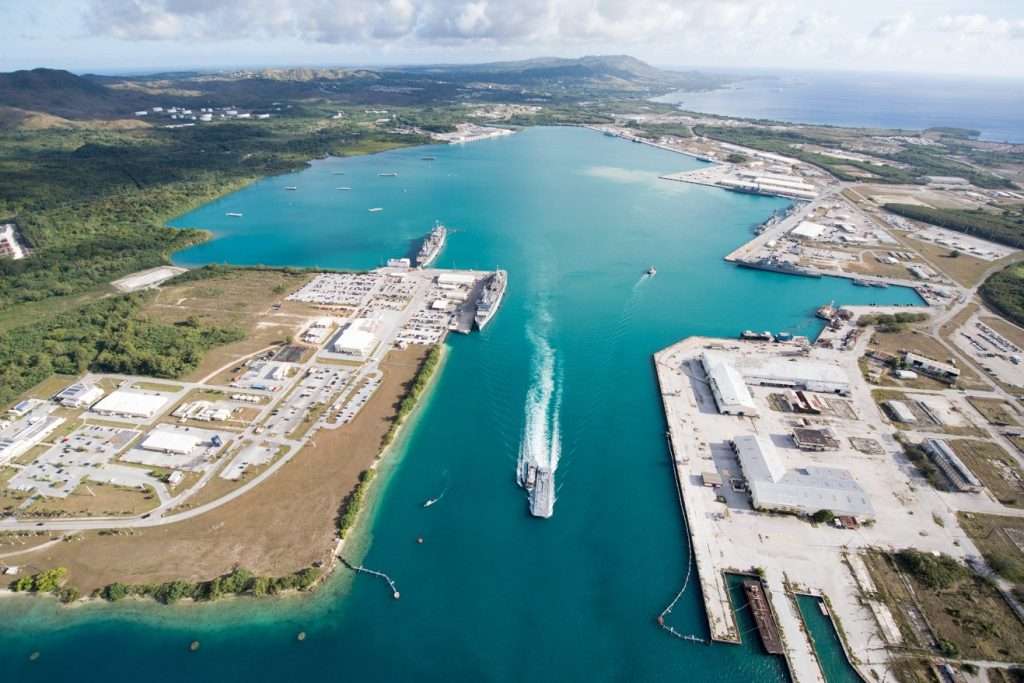
The open ocean is a critical for shipping and navigation, connecting Guam to other Pacific Island nations, Asia, and the United States. Located in the Pacific Ocean, Guam is an important hub for trade and commerce. Cargo vessels, tanks, and other ships transport goods and resources throughout these regions effectively. Proper navigation practices, including abiding by maritime pollution regulations (MARPOL), help minimize environmental impact of shipping on the ocean.
Next Generation Science Standards Alignment
LS1.A: Structure and Function – Organisms have structures that serve different functions, such as streamlined bodies and fins for efficient movement
LS1.D: Information Processing – Marine organisms demonstrate a variety of senses beyond the typical 5, and their hunting strategies involve information processing.
LS1.C: Organization for Matter and Energy Flow in Organisms – Adaptations in respiratory systems, such as gills and swim bladders, allow marine organisms to efficiently intake oxygen.
LS4.C: Adaptation – Organisms have specific adaptations that allow them to thrive in different environments, such as low oxygen or anaerobic conditions.
Many types of vessels come to Guam ports including Oil/Chemicals Tankers, Container Ships, Vehicle Carriers, Replenishment Vessels, and Military Ops. Over 100,000 containers pass through the ports of Guam annually providing for over 500,000 residents in the Western Pacific. The US provides 60% of Guam’s imported goods with the rest coming from Japan, Taiwan, Philippines, and Hong Kong. Guam has become one of six in the new MARAD program on the Designated Marine Highway Route. This route is a navigable waterway capable of transporting freight.
The ships that travel to Guam all follow MARPOL regulations. MARPOL is The International Convention for the Prevention of Pollution from Ships. It is the main instrument used to protect the environment from accidental and intentional contamination from commercial vessels and marine operations.
PowerPoint: Open Ocean

Contact NAMEPA
(203) 255-4686
contact@namepa.net
21 Davis Hill Road
Weston, CT 06883
United States
North American Marine Environment Protection Association (NAMEPA) is a tax-exempt 501(c)(3) nonprofit organization.
Industry
- MSP® Program
- MEPA Program
- MARPOL
- Join NAMEPA
- Industry Events
© Copyright 2024 North American Environment Protection Association