
Planet & Ocean Discovery Series: Guam - Coastal Habitats
Habitats & Adaptations
Background
Coastal habitats on Guam have a variety of characteristics and adaptations. For example, coral reefs are made of tiny colonies of coral polyps that build calcium carbonate skeletons, providing both a structure and habitat for marine organisms. Mangrove forests thrive along coastlines with their specialized root systems capable of tolerating saline conditions and providing shelter for juvenile fish, crustaceans, and even birds. Seagrass beds composed of flowering plants have specialized adaptations, serving as a food and habitat for species. Sandy beaches provide feeding and nesting grounds for species like sea turtles and burrowing crabs.
Key Vocabulary
Acidification
Aquatic
Erosion
Greenhouse Gas
Intertidal
Mangrove
Reef
Sequestration
Symbiotic
Sustainable
Terrestrial
Thermal
Learning Objectives
Students will be able to identify the key roles of coral reefs in marine ecosystems and explain their importance to local fisheries and biodiversity.
Students will be able to describe the specific adaptations of mangroves and seagrasses that enable them to thrive in Guam’s coastal environments.
Students will be able to analyze the impact of environmental changes, such as erosion or habitat loss, on the dynamics and resilience of coastal habitats like mangroves and seagrass beds.
Students will be able to illustrate how the interconnected relationships within marine food webs affect the flow of energy and the balance of marine ecosystems.
Next Generation Science Standards Alignment
LS2.A: Interdependent Relationships in Ecosystems – Coral reefs in Guam exemplify interdependent relationships within marine ecosystems. Coral polyps build the reefs, providing habitat and food for a variety of species, including fish and invertebrates. For example, parrotfish help control algae growth on the reefs, maintaining the health of the coral structure. The interactions among these species, such as clownfish benefiting from sea anemones for protection while cleaning them of parasites, highlight how each organism depends on others for survival and ecosystem balance.
LS2-4: Ecosystem Dynamics, Function, and Resilience – Mangroves and seagrass beds in Guam illustrate the concept of ecosystem dynamics and resilience. Mangroves stabilize coastal soils with their extensive root systems, while seagrass beds prevent erosion and provide essential habitats for marine life. If mangroves or seagrass beds are damaged, the resulting loss of habitat and shoreline stabilization can lead to increased erosion and reduced biodiversity. This example shows how changes in one part of an ecosystem can impact its overall health and functionality, demonstrating the interconnected nature of these coastal habitats.
Coral Reefs
Coral reefs, which resemble bustling underwater cities, are core ecosystems found on Guam. The limestone structures that make up these reefs were built over thousands of years by tiny organisms known as coral polyps.
Like the tropical rainforest on land, coral reefs are home to a wide range of marine creatures, including numerous colorful fish and graceful eels. Because they provide numerous animals with shelter and food, these reefs are crucial to the well-being of the marine ecosystem. The reefs are pivotal for supporting fish populations that are significant for neighborhood fisheries. The reefs are home to numerous species of fish that people rely on for food. Reefs that are healthy mean that fisheries are productive, which is important for the local economy and food supply.
Coral reefs provide a complex environment with numerous hiding places, places where marine life can hunt, and places where they can thrive. From the shallow, sun-drenched waters where vibrant coral grows to the deeper, darker areas where other creatures lurk, the reef offers a variety of habitats.
Species living in coral reefs have evolved a range of remarkable adaptations to thrive in this dynamic environment:
Camouflage: Many reef fish and invertebrates have evolved colors and patterns that blend into the coral, helping them avoid predators. For instance, the leaf fish mimics coral and algae to avoid detection.
Specialized Feeding: Some species have specialized mouthparts or feeding strategies adapted to their diet. For example, parrotfish have beak-like jaws to scrape algae from coral surfaces, while butterflyfish have long snouts to extract small invertebrates from crevices.
Mutualistic Relationships: Many reef species engage in mutualistic relationships, where both parties benefit. Clownfish and sea anemones are a classic example; clownfish are protected from predators by the anemone’s stinging tentacles, while they keep the anemone clean by eating parasites.
Reproductive Strategies: Coral reef species often have complex reproductive strategies. For example, the humphead wrasse, a type of fish that lives on the reef, can actually change from a female to a male as it gets older. This special ability helps make sure there are enough males around to help with reproduction, which is important for keeping their population healthy and strong.
Behavioral Adaptations: Some species exhibit unique behaviors to adapt to their environment. For example, certain fish build and maintain territories, while others, like the cleaner wrasse, set up cleaning stations to remove parasites from other fish.
Red mangroves have developed key adaptations to thrive in high salinity environments. Their roots filter out salt from seawater, allowing them to absorb fresh water, and any remaining salt is excreted through their leaves. Additionally, their prop roots have lenticels, small openings that allow oxygen to diffuse into the roots, essential for breathing in the low-oxygen, waterlogged soils where they grow.
Mangroves
Mangroves on Guam are primarily found in estuaries, tidal flats, and sheltered coastal areas. These regions are characterized by brackish water where the sea meets freshwater from rivers and streams. The mangrove forests help stabilize the shoreline and provide essential ecological services.
Mangroves are remarkably adapted to survive in their challenging coastal environments, where saltwater and freshwater mix. One of their primary adaptations is their ability to manage high salinity. Mangrove roots are equipped to filter out salt from seawater, ensuring that only fresh water is absorbed. Additionally, many mangroves have specialized glands on their leaves that excrete excess salt. This process helps them maintain a balanced internal environment despite the high salt levels in their surroundings.
The root systems of mangroves are also uniquely adapted to their environment. Some species, like the red mangrove, have aerial roots that extend above the water. These prop roots not only provide support in the soft, muddy soil but also help stabilize the tree and reduce coastal erosion. Another adaptation, seen in black mangroves, is the development of pneumatophores—spongy, root-like structures that protrude from the mud. These pneumatophores are essential for oxygen exchange, allowing the tree to breathe in waterlogged soils. Overall, the complex root systems of mangroves help anchor the trees in unstable sediments and trap sediments, further stabilizing the shoreline.
Mangrove seedlings have their own set of adaptations to ensure successful establishment. Many mangrove seeds, or propagules, are adapted to float in saltwater. This buoyancy allows them to disperse over long distances before settling in suitable locations. Additionally, some mangrove species practice vivipary, where seeds germinate while still attached to the parent tree. This adaptation provides the young seedlings with a head start in a protected environment before they fall into the water and begin to establish themselves in the mud.
Physically, mangroves have evolved features to cope with their harsh environment. Their leaves often have a thick, waxy coating that helps reduce water loss and protect against salt damage. This coating ensures that the leaves retain moisture and remain functional in the high-salinity environment. The stilt-like roots of some mangroves, such as the red mangrove, provide additional support in the shifting substrate and assist in sediment trapping.
Seagrass Beds
Seagrass beds around Guam are crucial coastal habitats with distinct adaptations that support a diverse range of marine life. Unlike algae and seaweeds, which are protists, seagrasses are true flowering plants with roots, stems, and leaves. The seagrass species found in Guam include needle grass (Halodule uninervis), tape grass (Enhalus acoroides), and spoon grass (Cymodocea rotundata), each with unique adaptations suited to the island’s coastal environment.
The roots of seagrasses anchor them securely in the sandy and muddy seabeds typical of Guam’s shallow lagoons and coastal areas. This anchorage prevents sediment erosion and stabilizes the substrate, which is essential for maintaining the health of the coastal ecosystem. The roots also play a vital role in nutrient uptake, absorbing essential minerals and organic matter from the sediment, while the leaves capture sunlight and exchange gases with the water.
Seagrass beds in Guam provide critical habitats and nursery grounds for various marine species. Juvenile fish, such as emperor fish and rabbitfish, utilize these beds as protected areas where they can grow and develop away from predators. The dense seagrass beds offer shelter and food for numerous marine organisms, including cardinal fish, anemones, and snails. Sea turtles, such as the green sea turtle, graze on the seagrass, relying on it as a primary food source.
Female turtles instinctively return to the beaches where they were born, ensuring that their eggs are laid in an environment suited for hatching. The sand provides a safe, insulated place for the eggs to develop until they hatch, and the hatchlings make their way to the sea.
Sandy Beaches
Sandy beaches on Guam offer distinctive habitats that support a diverse range of species through specialized adaptations. These beaches are composed of fine to coarse sand, which originates from the erosion of coral reefs, shell fragments, and volcanic rock. The gentle slope of the sandy substrate creates a gradual transition between the land and sea, forming a unique coastal environment.
The beach environment on Guam is highly dynamic, with constant changes in sand distribution and shoreline due to tidal movements and wave action. This dynamic nature results in different beach zones, including high-energy areas exposed to strong waves and low-energy zones protected by offshore reefs. These variations in energy and exposure influence the types of plants and animals that can thrive in each zone.
In the high-energy zones, where waves are stronger, species have adapted to withstand the force of the surf and shifting sands. Conversely, in the low-energy zones, where conditions are more stable, different species flourish. These variations in beach zones help create a mosaic of habitats, each supporting unique communities of flora and fauna.
Summary
Guam’s coastal environments are rich in diverse habitats, each with unique adaptations that support various marine and terrestrial life. Coral reefs, built over thousands of years by coral polyps, serve as crucial ecosystems akin to underwater cities, offering shelter and food to numerous marine species. Reef inhabitants, such as the steephead parrotfish, control algae growth and contribute to sandy beaches through their feeding activities. The saddleback butterflyfish uses bright colors for camouflage and protection against predators.
Red mangroves, with their aerial roots, stabilize coastal soils and manage high salinity by filtering salt from seawater. Black mangroves adapt to waterlogged conditions with pneumatophores that allow them to breathe. Mangroves in general help prevent shoreline erosion and support diverse coastal life through their specialized root systems and salt-excreting leaves.
Seagrass beds, home to species like needle grass and tape grass, anchor in sandy and muddy seabeds, preventing erosion and supporting marine life. These beds provide important nursery grounds and food sources for fish and sea turtles. Green sea turtles use Guam’s sandy beaches for nesting, leveraging their strong flippers to dig nests and ensuring that eggs develop in a safe environment.
Sandy beaches on Guam vary from high-energy areas with strong waves to low-energy zones sheltered by reefs. This variation creates different habitats for plants and animals adapted to each zone’s conditions. Overall, Guam’s coastal habitats are interconnected systems, each contributing to the island’s rich biodiversity and ecological balance.
Environmental Importance
Background
Coastal habitats play critical roles in maintaining the health and functionality of marine ecosystems. Coral reefs serve as biodiversity hotspots supporting fish, invertebrates, and other marine species. Acting as a natural barrier, coral reefs protect coastlines from erosion and storm surges by breaking wave attenuation (energy). Mangrove forests serve as important nursery grounds for species and with their intricate roots, mangroves filter pollutants and stabilize the coastline. Seagrass beds provide food, oxygen production, and nursery habitats. Sandy beaches have importance for recreational opportunities for humans, but also nesting sites for species.
Key Vocabulary
Biodiversity
Carbon cycle
Carbon sink
Energy
Habitat
Food web
Interdependence
Pelagic
Photosynthesis
Learning Objectives
- Students will be able to explain how producers, herbivores, carnivores, and omnivores in the ocean interact through feed relationships.
- Students will be able to analyze how changes in one population can cascade through the food web.
- Students will be able to identify the role of phytoplankton in the carbon cycle and its importance for a healthy environment.
- Students will be able to explain how the ocean acts as a carbon sink, absorbing carbon dioxide from the atmosphere.
Next Generation Science Standards Alignment
LS2.A: Interdependent Relationships in Ecosystems –The intricate web of the marine food web exemplifies interdependent relationships within an ecosystem. Primary producers, like phytoplankton, capture energy from the sun and form the base of this food chain. These producers are consumed by primary consumers, such as zooplankton, who transfer energy to the next level. Secondary consumers, including fish and smaller shrimp, then feed on the primary consumers. Finally, tertiary consumers, like larger fish and sharks, occupy the top of the food chain by preying on secondary consumers. This interconnected web demonstrates how all organisms in the marine ecosystem rely on each other for survival and the flow of energy.
LS2-5: Ecosystem Dynamics, Function, and Biodiversity – Within a marine food web, changes in one population can have cascading effects on other populations. Imagine a scenario where overfishing significantly reduces the population of a specific type of fish (primary consumer) that feeds on plankton (primary producer). This decrease in fish would lead to an increase in plankton populations as there are fewer predators to consume them. However, an unchecked rise in plankton could deplete the nutrients available for other organisms, ultimately affecting the entire food web. This example demonstrates how a seemingly isolated change in one population can have rippling effects throughout the interconnected web of marine life.
Coral Reefs
Coral reefs around Guam are crucial to the island’s environment and local communities, providing a range of ecological and economic benefits. These reefs are teeming with diverse marine life, including vibrant fish, invertebrates, and algae, all of which rely on the reef’s complex structures for shelter and sustenance. The reefs around Guam serve as essential habitats for numerous species, including commercially important fish and those at risk of extinction. This biodiversity supports intricate food webs and maintains the overall health of Guam’s marine environment.
In addition to fostering biodiversity, Guam’s coral reefs offer significant ecosystem services that protect the island’s coastlines. They act as natural barriers against wave action, mitigating the impact of storms and preventing coastal erosion. This protective function helps safeguard Guam’s shorelines, reducing the risk of damage to infrastructure and providing crucial protection for coastal communities against severe weather events.
The coral reefs around Guam also play a vital role in supporting local fisheries. They provide key breeding, feeding, and nursery grounds for many fish species that are central to both commercial and subsistence fishing. Healthy reefs ensure abundant fish populations, which are essential for food security and the economic stability of Guam’s fishing industry. A decline in reef health could lead to reduced fish stocks, impacting the livelihoods of local fishers and food availability.
These reefs are instrumental in nutrient cycling within Guam’s coastal waters. By absorbing and recycling nutrients such as nitrogen and phosphorus, the reefs help maintain water quality and prevent the overgrowth of algae. This nutrient regulation is crucial for avoiding harmful algal blooms, which can degrade marine habitats and disrupt the balance of the ecosystem.
Guam’s coral reefs also attract tourists and recreational divers, contributing to the island’s economy through eco-tourism. The colorful and diverse marine life draws visitors from around the world, supporting activities like snorkeling and diving. This tourism not only generates economic benefits but also raises awareness about the importance of coral reef conservation, encouraging efforts to protect these valuable ecosystems.
Video: Whitetail damselfish (Dascyllus aruanus), also known as the humbug damselfish or banded humbug in Cocos Lagoon.
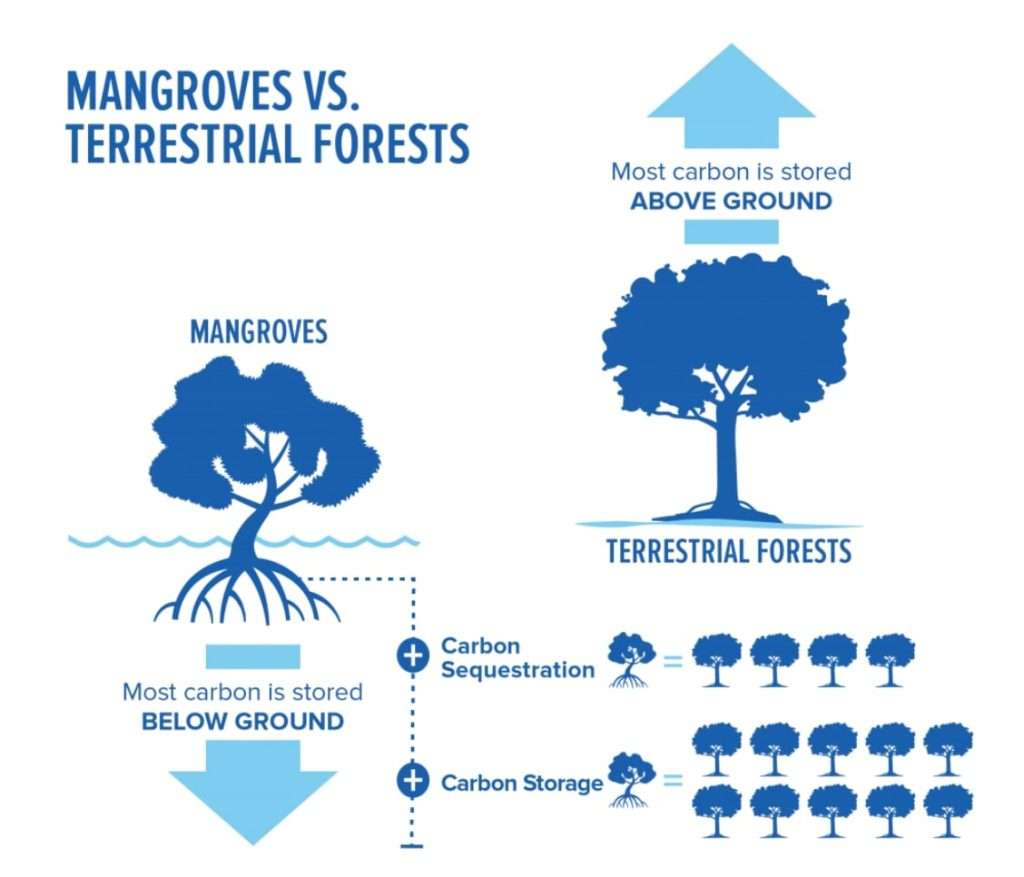
Image: Carbon absorption in mangroves versus terrestrial forests.
Source: (Reef Resilience Network, 2020).
Mangroves
Mangrove forests are the swamps of the tropics, found along the coast of tropical and subtropical countries they are a coastal habitat that exist in tidal zones of saltwater that receive little if any fresh water contributions. Nearly 75 percent of tropical coastlines, defined as 25 degrees north and 25 degrees south of the equator, have some kind of mangrove tree or shrub. With very little freshwater influence via rivers or streams to water the elaborate root systems, they have leaf and root adaptations to accommodate and rid the plant of excess salt while holding on to the freshwater necessary for survival.
Mangrove forests play a vital role in the protection and economy of coastal communities. The unique properties and structure of the root systems provide support for the soil and sand of the coastal communities lending a hand in protection from erosion, storms and waves while at the same time providing homes and refuge for many species of fish and crustaceans. The richness and biodiversity of these ecosystems is an excellent source of food and income, making life sustainable for these (sometimes) remote islands.
The interconnectedness of the root systems is excellent in their ability to sequester and remove carbon from the immediate environment (water, soil and plants) while contributing to the detrital food cycle-yes, decomposed organic matter is food for someone!
The amount of cover provided by the roots and leaves of the mangrove plant is estimated to protect 75% of game fish and 90% of commercial species of fish at some point in their life. Many of the species that rely on the mangrove cover are either endangered or threatened.
Knowing the role of that mangroves play in the food cycle and food chain of so many species has led to more pointed governmental regulation of these coastal communities. Coastal land use and development laws must now take into consideration the mangrove itself, along with the species known in the area and their International Union for Conservation of Nature (IUCN) status.
Sandy Beaches
Sandy beaches on Guam hold significant environmental importance, serving as vital nesting grounds for several key species, most notably sea turtles such as the endangered green and hawksbill turtles. These beaches provide safe, warm environments where female turtles can lay their eggs, ensuring the continuation of their populations. The sand provides an ideal substrate for egg incubation, with the temperature playing a crucial role in determining the sex of the hatchlings, thereby influencing future population dynamics.
Beyond their role as nesting grounds, Guam’s sandy beaches offer numerous ecosystem services that benefit both wildlife and human communities. They act as natural barriers against coastal erosion and storm surges, protecting inland areas from damage. This coastal protection is crucial for the preservation of other ecosystems such as mangroves and coral reefs, which are often located nearby and benefit from the stabilization provided by healthy beach systems.
The beaches also support a diverse array of organisms, from small invertebrates living within the sand to shorebirds that feed along the water’s edge. These organisms form a complex food web, contributing to the overall biodiversity of the coastal ecosystem. Additionally, sandy beaches play a role in nutrient cycling, with organic material from the ocean being deposited and decomposed, enriching the coastal environment.
For local communities and the tourism industry, sandy beaches are indispensable. They offer recreational opportunities, attract tourists, and support activities such as swimming, sunbathing, and beach sports. This not only enhances the quality of life for residents but also provides economic benefits through tourism and related services.
Video: Seagrass Bed – fish species
Seagrass Beds
Seagrass beds on Guam are ecologically significant, offering a wide range of environmental benefits and serving as crucial habitats for various marine species. These underwater meadows provide essential breeding and nursery grounds for many marine organisms, including fish, invertebrates, and sea turtles. Juvenile fish and invertebrates find shelter and food within the dense seagrass blades, which enhances their survival rates and supports the overall health of marine populations.
Seagrass beds play a pivotal role in maintaining water quality and clarity. They act as natural filters, trapping sediment and absorbing excess nutrients from the water, which helps to prevent harmful algal blooms and maintain the health of adjacent coral reefs. This filtration process is vital for the balance of marine ecosystems, as it ensures that the waters remain clear and conducive to the growth of other critical habitats like coral reefs.
The root systems of seagrass are incredibly effective at stabilizing the seabed, reducing erosion, and protecting coastlines from the impacts of waves and storms. This stabilization helps to prevent the loss of shoreline and protects coastal infrastructure, contributing to the resilience of Guam’s coastal zones.
Seagrass beds are also significant carbon sinks, sequestering carbon dioxide from the atmosphere and storing it in their biomass and sediment. This carbon sequestration capability makes them vital in mitigating the effects of increased atmospheric CO2 levels, although this benefit is part of their broader ecological importance.
Biodiversity within seagrass ecosystems is high, as they support a myriad of marine species, including economically important fish species and endangered species like dugongs and sea turtles. The presence of seagrass beds contributes to the overall health and diversity of Guam’s marine ecosystems, supporting fisheries and providing food and habitat for a variety of marine life.
In addition to their ecological benefits, seagrass beds have economic and recreational value. They support commercial and subsistence fishing, which is vital for local communities. The biodiversity and beauty of these underwater meadows also attract tourists, supporting activities such as snorkeling and diving, which are important for Guam’s tourism industry.
Summary
Coastal habitats play critical roles in maintaining the health and functionality of marine ecosystems on Guam. Coral reefs act as biodiversity hotspots, supporting diverse marine life and protecting coastlines from erosion and storm surges, thus safeguarding both the environment and coastal communities. Mangrove forests serve as vital nursery grounds and help stabilize the coastline, filtering pollutants with their intricate root systems, thereby enhancing water quality and preventing coastal degradation. Seagrass beds provide essential breeding and nursery habitats, enhance water quality, and act as significant carbon sinks, contributing to climate regulation and the overall health of marine environments. Sandy beaches are crucial nesting sites for species like sea turtles and offer important ecosystem services, including coastal protection and recreational opportunities for humans, highlighting their multifaceted environmental importance. Preserving these coastal habitats is essential for maintaining the balance and resilience of Guam’s marine ecosystems and ensuring their continued benefits for future generations.
The Changing Climate
Background
Coastal habitats on Guam are extremely vulnerable to the impacts of climate change. Rising sea levels pose threats by increasing coastal erosion, inundating low-lying areas. Ocean warming and acidification can cause coral bleaching and disrupt the balance coral reef systems offer. Extreme weather events such as tropical storms and increased rainfall can lead to habitat degradation, sedimentation, and pollution runoff, all affecting the overall health and resiliency of these habitats.
Key Vocabulary
- Atmospheric
- Greenhouse Gas
- Ocean Acidification
- Preserving
- Symbiotic
- Thermal
Learning Objectives
- Students will describe how carbon dioxide (CO2) from the atmosphere dissolves in seawater to form carbonic acid, leading to a decrease in pH and increased ocean acidity.
- Students will define coral bleaching and explain how environmental stressors, such as temperature changes, light exposure, and pollution, lead to the expulsion of symbiotic algae from coral tissues.
- Students will describe how increased sea surface temperatures provide energy for the development of hurricanes, cyclones, and typhoons.
Next Generation Science Standards Alignment
ESS3.B: Natural Hazards: The students will learn that typhoons are increasingly frequent and affect coastal habitats, causing erosion, inundation, and destruction. Scientists believe that the intensity and frequency of these storms are influenced by climate change.
ESS3.C: Human Impacts on Earth Systems: The students will learn that human activities contributing to rising temperatures and climate change affect storms in coastal regions. Climate change results in rising sea levels, ocean warming, and coral bleaching.
ESS3.D: Global Climate Change: The students will learn that there are global observations of increasing atmospheric CO2 emissions and rising ocean temperatures. Earth’s interconnected systems create feedback loops that amplify the impacts of climate change on coastal habitats.
Ocean Acidification
Ocean acidification occurs due to the uptake of carbon dioxide (CO2) from the atmosphere by the ocean. When CO2 dissolves in seawater, it forms carbonic acid, which can lower the pH of the water. This process is known as ocean acidification.
Phytoplankton convert sunlight and CO2 into oxygen and organic compounds through photosynthesis. This process also helps to remove CO2 from the atmosphere and store it in the ocean in the form of organic matter. When phytoplankton dies, their carbon-rich bodies sink to the ocean floor and decompose by bacteria. This process releases CO2 back into the water in the form of dissolved CO2.
The ocean takes up about 25% of the CO2 emitted by human activities, such as burning fossil fuels and agriculture practices. This causes an increase in the concentration of dissolved CO2 in the ocean, leading to ocean acidification.
As the concentration of dissolved CO2 in the ocean increases, it reacts with water molecules to form carbonic acid, which dissociates into bicarbonate ions (HCO3-) and hydrogen ions (H+). With the increase in H+ ions, the pH of the water decreases, making it more acidic. As the ocean becomes more acidic, the concentration of carbonate ions (CO32-) in the water decreases. This is significant because carbonate ions are used by marine organisms, such as coral reefs and shellfish. It can make it harder for them to build their skeletons and form their shells. It can also change the balance of the marine food web and reduce biodiversity.
Ocean acidification also reduces the ability of phytoplankton to photosynthesize and store CO2 ultimately reducing the ocean’s capacity to remove CO2 from the atmosphere, leading to a positive feedback loop that amplifies the warming of the climate.
Overall, ocean acidification is a serious environmental issue that can have a wide range of negative impacts on the marine ecosystem.
Coral Bleaching
Coral bleaching occurs when corals are stressed by changes in environmental conditions. Changes include things like temperature, light, nutrients, and pollution. The stress causes the corals to expel the symbiotic algae that lives in their tissues, causing them to turn completely white. Coral bleaching does not kill the coral, they are able to survive a bleaching event, however, they are more susceptible to stress and mortality when it occurs.
Bleaching’s most common cause is rising ocean temperatures. Thermal stress is a major issue for coral reefs. In 2005 the U.S. lost half of its coral reefs due to a bleaching event that was found to be a thermal stress incident greater than the previous 20 years combined. Thermal stress can also relate to a drop in temperatures. Bleaching has been observed from extreme cold temperatures as well.
Typhoons
Scientists believe that increased sea surface temperatures provide more energy to produce hurricanes, cyclones, and typhoons. Typhoons are large storms that follow a circular or spiral system of violent winds in a region of low atmospheric pressure. Typhoons are the same thing as hurricanes but are considered typhoons because of their location in the Pacific or Indian Ocean regions. Wind speeds can reach up to 314 km/h (195 mph) and mixed with heavy rains will cause substantial destruction to anything in their path.
Climate is thought to impact the intensity and frequency of these storms. Higher temperature causes more energy which leads to higher wind speeds. Temperatures are higher because of long-term warming for greenhouse gas emissions. Warmer temperatures hold more moisture which leads to heavier and more intense rainfall. Rising sea levels, also a result of global warming, play a part in these intense storms causing more coastal flooding.
Shipping & Navigation
Key Vocabulary
- Conservation
- Preserving
- Sustainable
Learning Objectives
- Students will explain how maritime transportation supports Guam’s economy by providing essential goods, fuel, and materials and facilitating tourism.
- Students will analyze how implementing sustainable practices in shipping can help preserve Guam’s coastal habitats and maintain the ecological balance of marine ecosystems.
Next Generation Science Standards Alignment
ESS3.C: Human Impacts on Earth Systems: The students will learn that maritime transportation plays a crucial role on Guam by supporting its economy and supply chain. Shipping is essential for importing necessary goods, fuel, and materials that benefit the island’s residents, businesses, and industries.
ETS1.B: Developing Possible Solutions: The students will learn that there is a requirement to develop strategies aimed at improving the reliability, affordability, and environmental sustainability of maritime transportation systems.

Contact NAMEPA
(203) 255-4686
contact@namepa.net
21 Davis Hill Road
Weston, CT 06883
United States
North American Marine Environment Protection Association (NAMEPA) is a tax-exempt 501(c)(3) nonprofit organization.
Industry
- MSP® Program
- MEPA Program
- MARPOL
- Join NAMEPA
- Industry Events
© Copyright 2024 North American Environment Protection Association